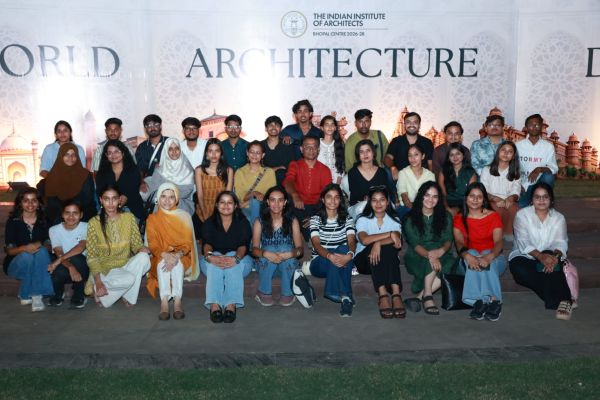
• Architects, urban planners and students participate at
Minto Hall; live craft demonstration becomes the highlight of the event
Bhopal: Architecture is not merely the art of
constructing buildings with brick, mortar and stone; it is a medium that shapes
a society’s culture, human dignity and environmental future. With this vision,
the Indian Institute of Architects (IIA), Bhopal Centre, organised a special
programme on Sunday evening at the historic Kushabhau Thakre International
Convention Centre (Minto Hall) on the eve of World Architecture Day 2026.
The programme was organised around this year’s global theme
for World Architecture Day, celebrated on October 5 - “Housing is a Human
Right, Build It.” The event witnessed the participation of senior
architects, urban planners, designers, architecture professionals and a large
number of students from across the city. Discussions focused on sustainable and
inclusive architecture, local cultural heritage and the future of the built
environment.
Newly appointed Chairman of the IIA Bhopal Centre, Architect
Hemant Vishwakarma, said that the programme began with tree plantation as a
message of responsibility towards nature and environmental conservation. He
said that architecture today is not limited to creating aesthetically appealing
and modern buildings; it also carries the responsibility of creating cities and
residential environments that are sustainable, inclusive, accessible and humane
in the face of changing climatic conditions.
Traditional Craftsmanship Meets Modern Architecture
The Live Craft Demonstration emerged as one of the
major highlights of the programme. It offered a unique glimpse into the
connection between traditional craftsmanship and contemporary architectural
practices. Live demonstrations were presented in carpentry, fabrication,
pottery and modern textured wall techniques, along with the traditional craft
of Zari-Zardozi, an important part of Bhopal’s cultural identity.
Architects and students were introduced to the finer aspects
of construction materials, techniques and craftsmanship. Experts highlighted
that a deeper understanding of local materials, traditional techniques and
craftsmanship enables architects to develop more sensitive and sustainable
designs. They emphasised that a meaningful integration of traditional crafts
with modern architecture can help preserve local identity while giving
contemporary construction greater cultural relevance.
IIA Announces Institutional and Student Membership
During the programme, the IIA Bhopal Centre also announced
its institutional and student membership initiatives. A roadmap for
upcoming strategic meetings on the Centre’s master plan was also presented,
with the objective of ensuring its planned and comprehensive development.
Photography and sketching competitions were organised to
provide young architecture students with a creative platform and encourage them
to explore architecture, heritage and the built environment through their own
perspectives.
Senior Architects Share Experiences
One of the key sessions, ‘In Conversation with Senior
Architects,’ featured two senior architects from the city who shared their
experiences and perspectives on the changing direction and challenges of Indian
architecture.
The discussion covered contemporary architecture in the
Indian context, preservation of local identity and heritage, as well as the
evolving needs of future cities.
Architecture Quiz Tests Knowledge of Local Heritage
To make the programme engaging and intellectually
stimulating, a multi-stage Architecture Quiz and the knowledge-partner
activity ‘Know Your Architects’ were organised. The activities featured
questions related to historical and contemporary architecture, local heritage
and the urban fabric of Bhopal.
The quiz placed special emphasis on the architectural
heritage of Bhopal and Madhya Pradesh. Participants were asked questions
related to prominent historical and architectural landmarks, including Gauhar
Mahal, Jama Masjid, Fatehgarh Fort, Bharat Bhavan, Shaurya Smarak, Sanchi and
Khajuraho.
Participants took enthusiastic part in the quiz and
demonstrated their knowledge of architecture and heritage across its various
rounds.
Special Video Showcase on Bhopal’s Heritage
A special video showcase focusing on one of Bhopal’s
prominent historic heritage buildings was also presented during the programme.
The presentation highlighted the city’s architectural legacy, historical
significance and the need for heritage conservation.
The programme concluded with the felicitation of winners of
various competitions and quiz rounds. The IIA Bhopal Centre expressed its
gratitude to the senior architects, experts, students and all participants who
attended the event.
The Centre reiterated its commitment to continuing
meaningful initiatives aimed at preserving Bhopal’s architectural identity and
cultural heritage, while promoting the city’s urban aesthetics and
environmental sustainability through creative and responsible architectural
practices.