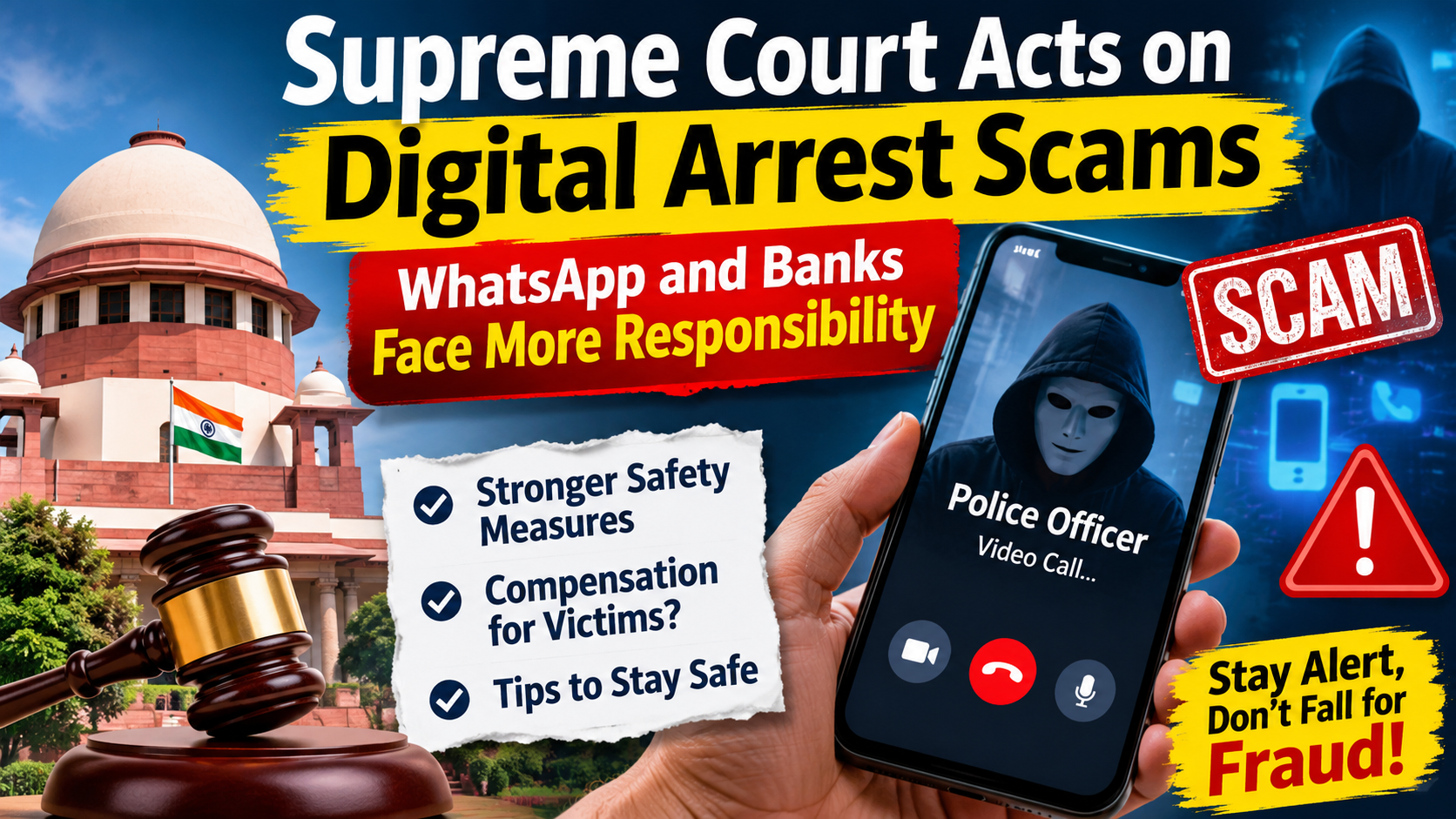
The Supreme Court has asked WhatsApp and other online platforms to suggest ways to stop digital arrest scams. It has also pushed for stronger action from banks, including compensation for victims if a bank's failure to follow proper checks leads to fraud.
Digital arrest scams have become a serious cybercrime problem in India. Fraudsters pretend to be police officers, CBI officials, customs officers or other government authorities. They threaten people with arrest and keep them under pressure through phone or video calls. Many victims are forced to transfer large amounts of money because they believe they are dealing with real officials.
Now, the Supreme Court wants technology platforms, banks and government agencies to take stronger steps to prevent these crimes.
In an order following its October 29 hearing, the Court asked WhatsApp and other online platforms to explain what they are doing to prevent digital arrest scams. They must also share their proposals with the Indian Cybercrime Coordination Centre (I4C).
The case is titled In Re: Victims of Digital Arrest Related to Forged Documents. The next hearing is scheduled for November 23, 2026.
Supreme Court Wants WhatsApp to Take Stronger Action
WhatsApp has been asked to submit details of the steps it plans to take against digital arrest scams and related cybercrimes.
During the hearing, senior advocate Kapil Sibal, representing WhatsApp, told the Court that the platform had already taken action against 9,400 accounts. He also said that WhatsApp was developing software to identify suspicious accounts and warn users.
The Court has asked WhatsApp and other concerned online platforms to submit their proposed safety measures to both the Court and I4C.
This step is important because scammers often use messaging platforms to contact victims, share fake identity cards and send forged legal documents. They may also use video calls to make their claims look genuine.
However, the responsibility does not end with blocking suspicious accounts. Platforms need effective systems to identify scam activity, respond quickly to complaints and prevent repeat offenders from targeting more people.
Banks May Have to Compensate Victims if They Fail to Act
The Supreme Court has also raised serious questions about the role of banks in preventing digital fraud.
According to the Court, banks have access to customers' transaction history. This information can help them identify unusual payments, such as a sudden transfer of a very large amount that does not match a customer's normal banking activity.
The Court has said that the RBI's proposed regulatory measures must include provisions requiring financial institutions to compensate victims when an investigation establishes that the fraud happened because the institution failed to exercise due diligence.
The compensation should not be less than the amount lost by the customer in such cases, according to the Court's order.
The Court has also suggested stronger safeguards. These may include temporarily stopping unusual or suspicious transactions, informing the nearest police station and physically verifying the transaction before allowing it to proceed.
This does not mean that every person who loses money in an online scam will automatically receive a refund from their bank. The key condition is that an investigation must establish a failure by the financial institution to follow its required checks.
The Reserve Bank of India has been asked to submit a list of authorised financial institutions before the next hearing. The proposed RBI directions are expected to be notified by November 30 and put into operation by December 31, 2026.
States and Police Agencies Must Also Report Scam Cases
The Supreme Court has asked law enforcement agencies in every state and Union Territory to submit details of digital arrest cases.
These reports must include the number of FIRs registered and the progress of investigations. Police agencies have also been asked to suggest ways to prevent these scams, identify offenders and improve prosecution.
The Directors General of Police (DGPs) across states and Union Territories will be responsible for ensuring that these directions are followed.
The Court's aim is to improve coordination between banks, online platforms, police agencies and government departments. A scam can involve several steps, from the first phone call to the movement of stolen money through different bank accounts. A coordinated response can help authorities act before the money disappears.
What Is a Digital Arrest Scam and How Does It Work?
A digital arrest is not a real legal process in India. It is a form of online fraud in which criminals pretend to be government or law enforcement officials.
The scam usually starts with a phone call or video call. The caller may claim that a parcel containing illegal items has been found in the victim's name, or that their Aadhaar card, bank account or mobile number is connected to a criminal case.
The fraudsters may show fake police uniforms, forged identity cards, fake court documents and false case numbers. They sometimes keep victims on video calls for hours and tell them not to contact family members or anyone else.
After creating fear, they demand money. They may describe the payment as a security deposit, verification amount or money required to clear the victim's name. In reality, the money goes to the scammers.
The Ministry of Home Affairs has warned that real law enforcement agencies do not conduct arrests through video calls or demand money to settle a case.
How to Protect Yourself From Digital Arrest Scams
The most important thing to remember is that no police officer or government agency can digitally arrest you through WhatsApp, Skype or another video-calling app.
If someone calls and claims that you are involved in a serious crime, do not panic. Do not transfer money, share your bank details, reveal an OTP or install an app at the caller's request.
Do not trust documents or video calls simply because they look official. Scammers can use fake uniforms, logos, identity cards and court orders to create fear. End the call and verify the claim by contacting the relevant government department or police station through its official contact details.
Never keep a suspicious video call running because someone threatens you with arrest. Speak to a trusted family member or friend before taking any action.
If money has already been transferred, act quickly. Call India's cybercrime helpline 1930 and report the incident at the official National Cyber Crime Reporting Portal: https://cybercrime.gov.in. Contact your bank immediately and share the transaction details. A quick report may help authorities and banks try to stop the money from moving further, although recovery is not guaranteed.
What Happens Next?
The Supreme Court will take up the matter again on November 23, 2026. It will review the proposed measures from WhatsApp and other online platforms, the RBI's regulatory steps and reports from law enforcement agencies.
The Court has made it clear that preventing digital arrest scams cannot be left to public awareness alone. Banks must take suspicious transactions seriously, online platforms must improve their safety systems and police agencies must strengthen investigations.
For people across India, the message is simple: a video call from someone claiming to be a police officer does not mean you are under arrest. Never transfer money because someone threatens you with a digital arrest.