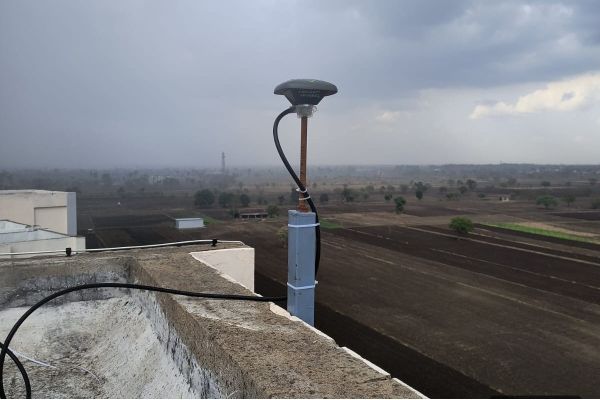
Sehore : The
National Atmospheric Research Laboratory, Department of Space, Government of
India, has set up a GNSS receiver system at VIT Bhopal University as part of
its North–South Chain for Ionosphere and Space Weather Observations under a
collaborative initiative. This facility marks a key milestone in strengthening
the University's research capabilities in space science, while reinforcing
collaborative research in space weather and indigenous navigation technologies
at VIT Bhopal University.
The advanced GNSS receiver will
enable continuous monitoring of critical ionospheric parameters, including
Total Electron Content (TEC), ionospheric scintillation, signal degradation,
loss of lock, and travelling ionospheric disturbances caused by equatorial
processes as well as solar and geomagnetic activity. The data generated through
the facility will support research in ionospheric science, space weather,
geodesy, and Positioning, Navigation and Timing (PNT) applications, while
contributing to India's expanding scientific capabilities in satellite
navigation and Earth observation.
Dr. Sharad Chandra Tripathi,
Senior Assistant Professor at VIT Bhopal University, who will oversee the
University's research collaboration with NARL scientists, said, “VIT Bhopal
University thanks Director, NARL, for enabling this collaboration. The
establishment of the GNSS receiver facility marks an important addition to our
research infrastructure and reflects the institute’s commitment to advancing
high-impact scientific research. This facility will enable continuous
observations of the ionosphere and create opportunities for interdisciplinary
research in GNSS, NavIC, and space weather, alongside providing students with
exposure to real-time scientific data and strengthen collaborative research in
this important domain.”
The collaboration now opens new
opportunities for faculty members, researchers, and students to engage in
advanced research in GNSS, NavIC, space weather, and geospatial technologies,
strengthening the University's research ecosystem and fostering future
collaborations with national research organisations.