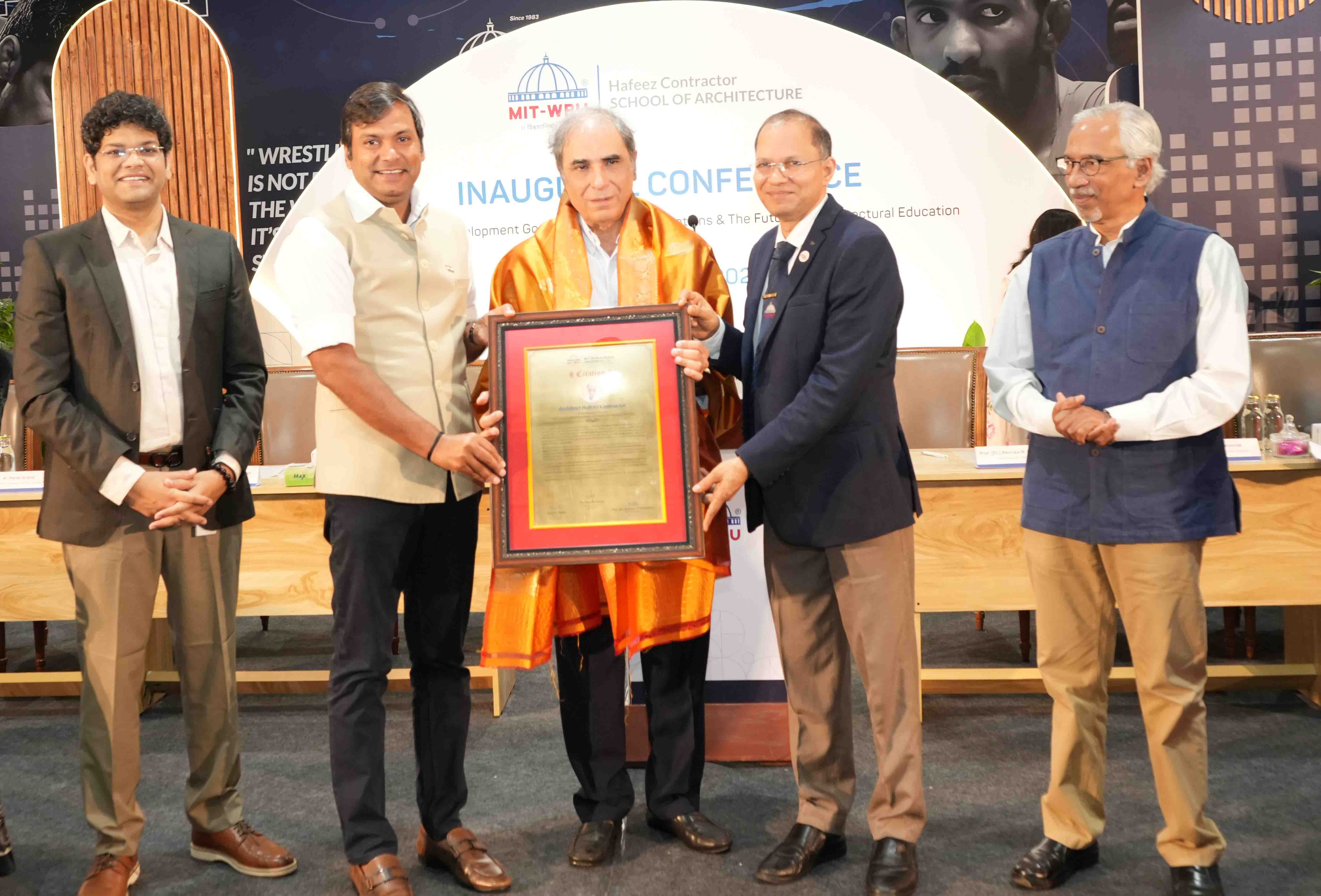
Pune: MIT
World Peace University (MIT-WPU), Pune, hosted the inaugural conference of the Hafeez
Contractor School of Architecture, where Architect Hafeez Contractor, Padma
Bhushan awardee and Chief Guest, called for a new approach to city planning,
emphasising the need to protect forests, farmland and wetlands while exploring
higher-density, three-dimensional approaches to accommodate growing urban
populations.
Pavan
Anand, Fine Jeweller,
and Architect Pushkar Kanvinde attended the conference as Guests of
Honour. The programme also brought together MIT-WPU leadership, faculty members
and students, along with leading voices from architecture, design, industry and
academia, to examine how architectural education must evolve in response to
rapidly changing cities, sustainability challenges and emerging technologies
such as artificial intelligence.
Speaking at
the conference, Architect Hafeez Contractor, said, “Being associated
with an architectural college that carries my name is a big responsibility.
Students must learn the basic principles of architecture and understand that
whatever they do should have a purpose. As our cities continue to grow, we have
to think about a new way of construction and rethink how we design our cities.”
He added, “The
way we have been expanding our cities, consuming farmland and forest land,
cannot continue. We have to protect our forests, farmland and wetlands because
if we destroy our environment, we cannot live. We have to think about new
approaches to construction and how we can build higher while considering cost
and the needs of millions of people coming to our cities. Our city planning
cannot remain two-dimensional; we have to think about our cities in three
dimensions. We also have to consider factors such as earthquakes and typhoons
and design buildings accordingly. Cement and steel are basic materials, but
there has to be modification so that we can build stronger. The way we design
our cities is going to shape the future, and I feel this school should concentrate
on creating new ideas because the future is theirs.”
Dr. Rahul
V. Karad, Executive President, MIT-WPU,
said, “Hafeez Contractor’s association with this school is an honour, but it
also places a greater responsibility on us to ensure that the institution
remains relevant to its time. Architecture influences how people live, work and
experience a city. With technology and artificial intelligence transforming how
we learn, design and work, academia and industry must work together to prepare
students for what tomorrow will require.”
Sharing his
perspective on creativity and interdisciplinary learning, Pavan Anand, Fine
Jeweller, said, “Architecture is a wonderful canvas for creativity, but
it is also about experience, how you feel in a space and how you relate to it.
Students should not restrict themselves to their degree. My own journey from
architecture to jewellery design has taught me that creativity can extend
across disciplines. Identify your individual sensibility, skill set and talent,
pursue what you are truly passionate about, and do not be afraid to take your
creative practice in a different direction.”
Highlighting
the importance of continuous learning, Architect Pushkar Kanvinde said, “Architecture
is an umbrella stream in the field of knowledge, and students have to take the
initiative to learn through experiences, experiments and by meeting people.
Your learning does not stop after five years; you have to become a lifelong
learner. With AI emerging as a disruptive technology, you have to go beyond it
and nurture the creativity that makes you a good architect.”
The
discussions at the conference centred on two key themes shaping the future of
architectural education. The first round-table, ‘Sustainability (SDGs) and
the Future of Architectural Education,’ examined the need to integrate
sustainability and the Sustainable Development Goals into architectural
learning and prepare students to respond to the changing needs of the built
environment.
The second
round-table, ‘Technology Interventions and Preparing B.Arch. Students for
Being Practice and Future Ready,’ explored the growing role of technology
in architecture and the need to equip students with skills that can help them
transition from academic learning to professional practice. Both sessions
included interactive discussions and Q&A sessions with students, enabling
them to engage directly with the participating experts.
The inaugural
conference highlighted the need for architectural education to keep pace with
changing urban realities, sustainability priorities and technological
developments, while equipping students to navigate the evolving profession.