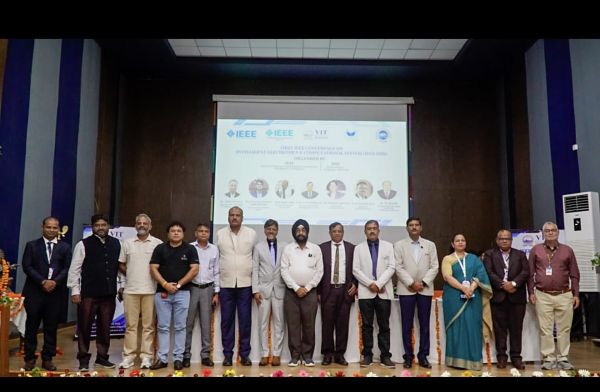
~ IECS 2026 Brings
Together Leading Researchers from India and Abroad
~ Over 2,300 Paper
Submissions, 232 Selected Following Rigorous Peer Review
Sehore : VIT Bhopal University successfully hosted the inaugural edition of
the IEEE International Conference on Intelligent Electronics &
Computational Systems (IECS 2026) on 17–18 July 2026, bringing together leading
researchers, academicians, industry experts and students from India and around
the world to discuss the latest advances in intelligent electronics,
computational systems and emerging technologies.
Organized by the School of Electrical and
Electronics Engineering (SEEE) in association with the IEEE Student Branch, the
two-day international conference witnessed an overwhelming response from the
global research community. More than 2,300 research papers were submitted
through the IEEE Conference Management Toolkit (CMT). Following a rigorous peer
review process, 232 papers were selected for oral presentation across nine
technical tracks, resulting in an acceptance rate of approximately 10 percent,
underscoring the conference's academic quality and selectivity.
The inaugural session was graced by Prof. Rajeev
Dixit, Vice Chairman, Atal Bihari Vajpayee Institute of Good Governance and
Policy Analysis, Bhopal, Madhya Pradesh, along with Prof. G.S. Tomar, Chairperson, IEEE
M.P Section; Dr. Manish Dixit, Chair Elect, IEEE MP Section; Dr. Jitendra
Aggarwal, RGPV; and Prof. M.P.S. Chawla, Secretary, IEEE M.P. Section,
senior leadership of VIT Bhopal University, faculty members, researchers and
students.
Over the course of two days, researchers
presented cutting-edge work spanning Data Science and AI, VLSI Design and Circuits, RF and Antenna
Design, Communication and Network, Electrical and Power System, IoT, Cloud and
Cyber Security, Signal and Image Processing, Constructional Technology, and
Healthcare and Bio Tech, fostering interdisciplinary collaborations and
knowledge exchange between academia and industry. The conference also provided
an important platform for young researchers and students to engage with global
experts and showcase their research contributions.
The conference received research contributions
from premier Indian institutions including IIT Indore, MANIT Bhopal, IIT Jammu,
NIT Puducherry, IITRAM Ahmedabad, IET DAVV Indore, Bennett University, BITS
Pilani and RGPV University, alongside international participation from
researchers representing France, Germany, the United States, the United
Kingdom, China, Belgium and several other countries. A key highlight of the
conference was the keynote address by Dr. Satya Gupta, President, VLSI Society of India, who spoke on
advances in VLSI design and outlined several research schemes and funding
opportunities available to scholars and students under the Chips to Startup
(C2S) Programme. He elaborated on the support extended to student researchers
under the scheme, encouraging young researchers to leverage these initiatives
to strengthen India's semiconductor research and innovation ecosystem. The
conference also featured a special panel discussion titled "Building a
Self-Reliant Semiconductor Ecosystem," where experts from academia,
government and industry deliberated on India's semiconductor ambitions,
manufacturing ecosystem, talent development and policy priorities.
Plenary talks were presented by Dr. Santosh Kumar Vishwakarma,
Chief Scientific Officer, Atal Bihari Vajpayee Institute of Good Governance and
Policy Analysis (AIGGPA), Bhopal. Invited talks were delivered by Dr. Vivek
Tiwari, Associate Professor, ABV-IIITM Gwalior, and Dr. Ambika P Shah,
Associate Professor, IIT Jammu, further enriching the technical discourse and
providing students and researchers with diverse perspectives from academia and
industry.
Dr. M. Suresh, Dean, School of Electrical and Electronics
Engineering (SEEE), and Dr. Ankur Beohar, Branch Counsellor, IEEE Student
Branch, VIT Bhopal University, said," “Our objective with the inaugural
IECS 2026 at VIT Bhopal was to create a globally relevant research platform
that encourages meaningful scientific dialogue and interdisciplinary
collaboration. The overwhelming response from researchers worldwide is a strong
affirmation of that vision. The conference brought together diverse
perspectives from academia and industry, creating opportunities for knowledge
exchange that extend well beyond the event.”
The successful conclusion of IECS 2026 reinforces
VIT Bhopal University's commitment to advancing high-quality research,
fostering international collaborations and creating platforms that drive
innovation in emerging technologies. The conference is expected to strengthen
academic partnerships and contribute to ongoing conversations around
intelligent electronics, computational systems and India's growing
semiconductor ecosystem.