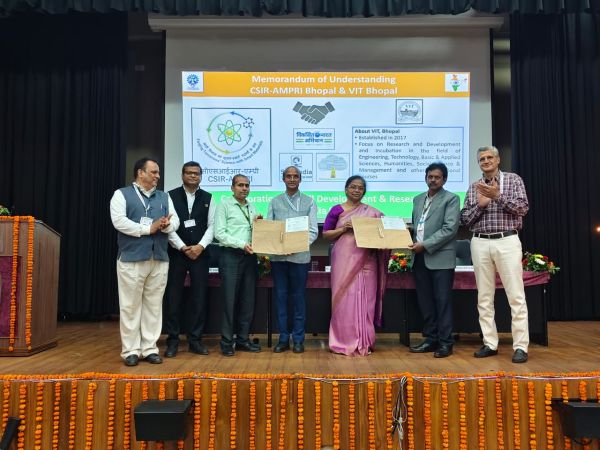
Sehore: In a significant
move towards strengthening advanced scientific research and innovation-led
education, and industry-oriented technological development, VIT Bhopal
University exchanged a Memorandum of Understanding (MoU) with CSIR-Advanced
Materials and Processes Research Institute (CSIR-AMPRI), Bhopal. The
collaboration brings together VIT Bhopal University’s focus on research-led
education and CSIR-AMPRI’s expertise in advanced scientific and industrial
research to drive interdisciplinary innovation across emerging technology
domains.
The MoU was exchanged in the
presence of Dr. (Mrs.) N. Kalaiselvi, Director General, CSIR and Secretary,
DSIR, Government of India, and Dr. Thallada Bhaskar, Director, CSIR-AMPRI,
Bhopal; while Dr. Anantkant Shukla, Deputy Registrar, and Dr. S. Balaguru,
Dean, School of Mechanical Engineering, represented VIT Bhopal University.
Under the MoU, both institutions
will jointly undertake sponsored research projects, collaborative PhD guidance,
student internships, faculty development programmes, workshops, and technology
transfer initiatives, while providing students and researchers with greater
exposure to advanced scientific infrastructure, applied research environments,
and industry-oriented problem solving.
Both VIT Bhopal and CSIR-AMPRI will
work together across a diverse range of domains including advanced materials,
additive manufacturing, artificial intelligence and machine learning, robotics,
biomaterials, aerospace and propulsion systems, renewable energy, computational
engineering, wireless communication, biomedical devices, VLSI and MEMS
technologies, image processing, UAV systems, thermal sciences, and sustainable
engineering applications, among other emerging fields.
By fostering knowledge exchange
and strategic collaboration, VIT Bhopal University aims to further strengthen
its academic and research ecosystem while enabling students and faculty members
to contribute more meaningfully towards technological advancement and
real-world solutions. The partnership aligns with the university’s broader
vision of nurturing future-ready talent equipped to address evolving
scientific, industrial, and societal challenges.
Representatives from both
institutions expressed confidence that the collaboration would contribute
towards building a stronger culture of interdisciplinary research, innovation,
and knowledge exchange, while supporting the development of impactful
technologies with long-term societal relevance.