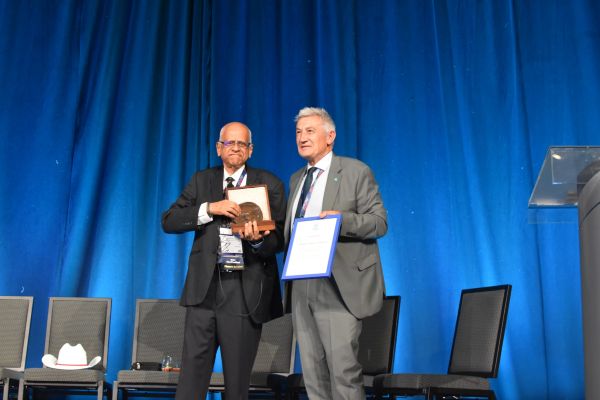
He has Received this Global Honour for Pioneering Crystal Engineering
Work which can help in optimizing drug solubility, stability, and mechanical
properties without altering the active drug molecule itself
Mandi: Professor Emeritus Gautam R. Desiraju has been
awarded the 14th Ewald Prize by the International Union of Crystallography
(IUCr) for pioneering the subject of crystal engineering and the supramolecular
synthon concept, and for establishing the structural significance of weak
hydrogen bonding and halogen bonding in molecular crystals and biology. The
Ewald Prize, awarded once every three years at the International Congress of
Crystallography, recognises outstanding contributions to the science of
crystallography, and the 2026 laureate, on 11th August 2026, Gautam
R. Desiraju, has been honoured at the IUCr Congress in Calgary, Canada.
Desiraju — an Emeritus
Professor at the Indian Institute of Science, Bengaluru, and a Distinguished
Professor at IKSMHA, IIT Mandi, among other affiliations — has described the
honour in characteristically direct terms.
Reflecting on the award, Professor Emeritus
Gautam R. Desiraju said, “The Ewald Prize is widely
considered the highest accolade a structural chemist or biologist can receive,
short of the Nobel Prize, singling out the complete professionalism of its
rigorous and confidential selection process.”
Speaking upon this Prof.
Laxmidhar Behera, Director, IIT Mandi, said, “Professor Desiraju’s
Ewald Prize is a matter of immense pride for IIT Mandi and Indian science. His
pioneering work in crystal engineering has transformed our understanding of
molecular interactions and opened new possibilities in pharmaceuticals and
advanced materials. We congratulate him on this well-deserved global
recognition.”
To mark the award, Desiraju
has published a lead article in IUCrJ (Volume 13, Part 5, September
2026) titled "Crystal clear. Engineering complexity," an
open-access, first-person retrospective on the field he helped found. The paper
accompanies the prize and forms part of a collection tied to the IUCr 2026
Congress.
From "anomalous" crystals to a design science
The article traces a
scientific journey that began during Desiraju's PhD at the University of
Illinois, where he was struck by a deceptively simple question: why do crystals
adopt the structures they do? At the time, the prevailing view — associated
with the physicist Kitaigorodskii — held that organic crystals were governed
chiefly by close packing. Desiraju's insight was to treat the exceptions
as the key.
His attention turned to weak
intermolecular forces, particularly the C—H···O interaction, which he and
Thomas Steiner ultimately validated as a genuine weak hydrogen bond in their
1999 book. Once dismissed as insignificant, these interactions are now recognised
as structurally and functionally important in both small-molecule crystals and
biological systems.
The supramolecular synthon
The conceptual heart of the
article — and of Desiraju's legacy — is the supramolecular synthon, a term he
defined in a landmark 1995 review. Borrowing from Corey's retrosynthetic logic
in molecular synthesis, Desiraju reframed the molecular crystal itself as a synthetic
target, one that could be "disconnected" into structural modules
assembled through predictable intermolecular interactions. This move, more than
any other, positioned crystal engineering within the chemical mainstream as a
form of synthesis rather than mere structural description.
The paper walks through how
this thinking scaled up: from binary and ternary cocrystals built on insulated,
hierarchically arranged synthons, to quaternary and even five- and
six-component molecular crystals — what Desiraju calls the "Mount Everest
of supramolecular solid state synthesis."
Real-world payoffs and open questions
The article connects these
ideas to tangible applications, most notably pharmaceutical cocrystals, which
improve the solubility and bioavailability of poorly water-soluble drugs and
have yielded around half a dozen marketed medicines built on crystal-engineered
logic. It also covers polymorphism and crystal structure prediction — where
Desiraju argues AI may fully solve the prediction problem within five to ten
years — and a newer sub-branch on mechanically deformable crystals that bend,
shear, or self-heal.
A holistic turn
The essay closes on a
philosophical note that will resonate with readers interested in Indian
Knowledge Systems. Desiraju frames the molecular crystal not as an assembly of parts
but as a complex, holistic system, explicitly setting the integrative
philosophies of older societies alongside Western reductionism. He argues that
a functional crystal depends on a synergy between the rigidity of strong bonds
and the adaptive subtlety of weak ones — and, extending the metaphor outward,
on the "essential oneness" of a shared human intellect across
cultures.
With more than 475
publications and over 80,000 citations, and having served as President of the
IUCr from 2011 to 2014, Desiraju's contributions have had a profound influence
on structural chemistry and crystallography worldwide. The Ewald Prize now
formally recognises a body of work that transformed crystal engineering from a
curiosity into a predictive, design-oriented discipline.