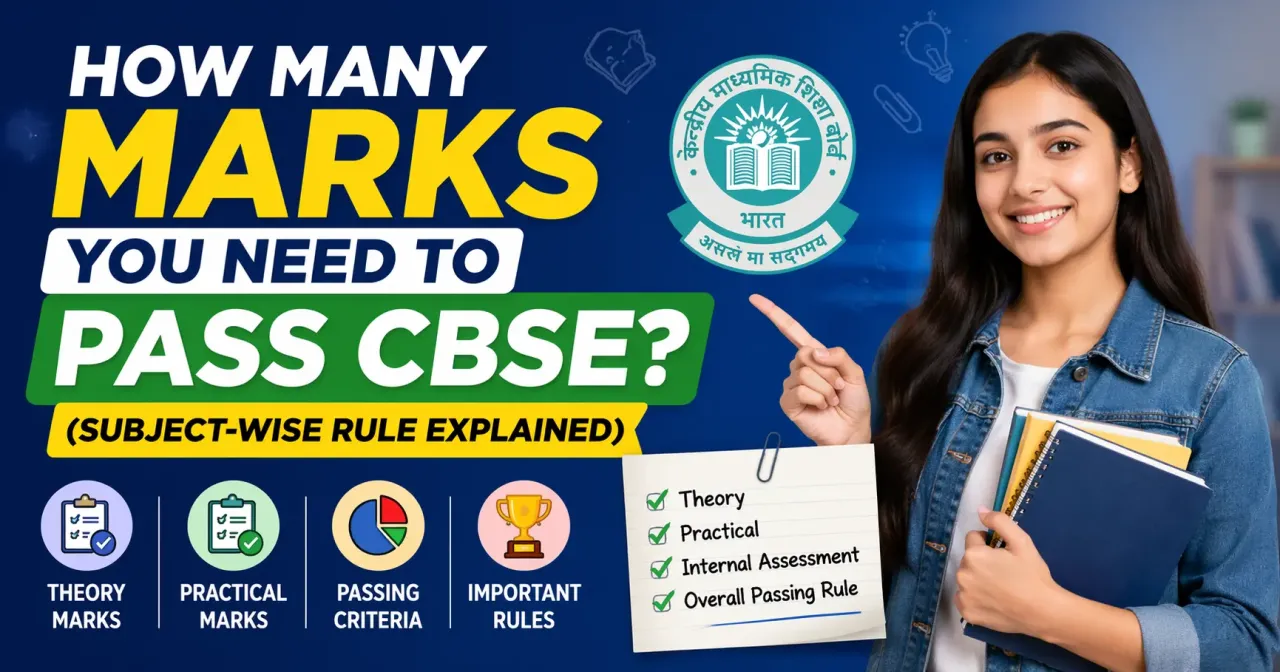
Every year, lakhs of students appear for CBSE board exams and one of the most common questions they have is: How many marks are needed to pass?
Understanding the passing rules of the Central Board of Secondary Education can help students stay calm and plan better. Here is a simple explanation of the subject-wise passing criteria for Class 10 and Class 12.
Minimum Passing Marks in CBSE
To pass any subject in CBSE, a student must score at least 33% marks.
This rule applies to:
- Theory exams
- Practical exams (if applicable)
- Overall subject total
This means you need 33% separately in theory and practical, and also in the combined total.
Passing Marks in Theory Exams
In most subjects, the theory paper is of 80 marks. To pass:
- You must score at least 26 marks out of 80
If you score below this, you may not pass the subject, even if your overall marks are higher.
Passing Marks in Practical Exams
Subjects like Science (Class 10) and Physics, Chemistry, Biology (Class 12) include practical exams.
- Practical exams are usually 20 or 30 marks
- You must score 33% in practicals as well
Even if you pass theory, failing in practical can lead to failing the subject.
Overall Passing Criteria
CBSE also checks your combined marks (theory + practical).
Example:
If a subject has 80 (theory) + 20 (practical) = 100 marks
You must score at least 33 marks in total
So, passing requires:
- 33% in theory
- 33% in practical
- 33% overall
CBSE Passing Marks Criteria (Class 10 & 12)
Basic Rule
| Criteria | Requirement |
|---|---|
| Minimum Passing Marks | 33% in each subject |
| Applies To | Theory + Practical + Overall |
Subject-wise Marks Breakdown
| Component | Total Marks | Passing Marks (33%) |
|---|---|---|
| Theory Exam | 80 | 26 marks |
| Practical / Internal | 20 | 7 marks |
| Total (Theory + Practical) | 100 | 33 marks |
For Subjects with 70 + 30 Pattern (Class 12)
| Component | Total Marks | Passing Marks |
|---|---|---|
| Theory Exam | 70 | 23 marks |
| Practical Exam | 30 | 10 marks |
| Total | 100 | 33 marks |
Important Passing Rules
| Rule | Explanation |
|---|---|
| Theory Passing | Must pass theory separately |
| Practical Passing | Must pass practical separately |
| Overall Passing | Total must be 33% or more |
| Fail Condition | Failing in theory or practical = fail in subject |
If You Fail
| Situation | What Happens |
|---|---|
| Fail in 1 Subject | Compartment exam allowed |
| Fail in 2 Subjects | Compartment exam allowed |
| Fail in More Subjects | May need to repeat year |
Grace Marks Rule
| Condition | Benefit |
|---|---|
| Close to passing | CBSE may give grace marks |
| Tough paper | Chances of grace marks increase |
| Final Decision | Depends on CBSE rules |
Quick Summary
| Requirement | Marks Needed |
|---|---|
| Pass Theory (80) | 26 |
| Pass Practical (20) | 7 |
| Pass Overall | 33 |
What Happens If You Fail in One Subject?
If a student fails in one or two subjects, CBSE gives another chance through compartment exams. These exams allow students to reappear and pass without losing a full academic year.
Role of Grace Marks
Sometimes, CBSE gives grace marks to help students pass. Grace marks can help you reach the minimum passing marks, but they are given based on rules and are not guaranteed.
This usually happens when:
- A student is very close to passing
- The paper was difficult
Important Tips for Students
Students should not only aim to pass but try to score higher to keep future options open. Even a small difference in marks can impact college admissions and career choices.
Understanding these rules helps reduce stress, especially for those worrying about just passing the exam.
Conclusion
To pass CBSE exams, students must score at least 33% marks in each subject, including theory and practicals. Knowing the subject-wise passing rules can help students stay prepared and confident.
Even if things don’t go as planned, options like compartment exams and grace marks provide support.