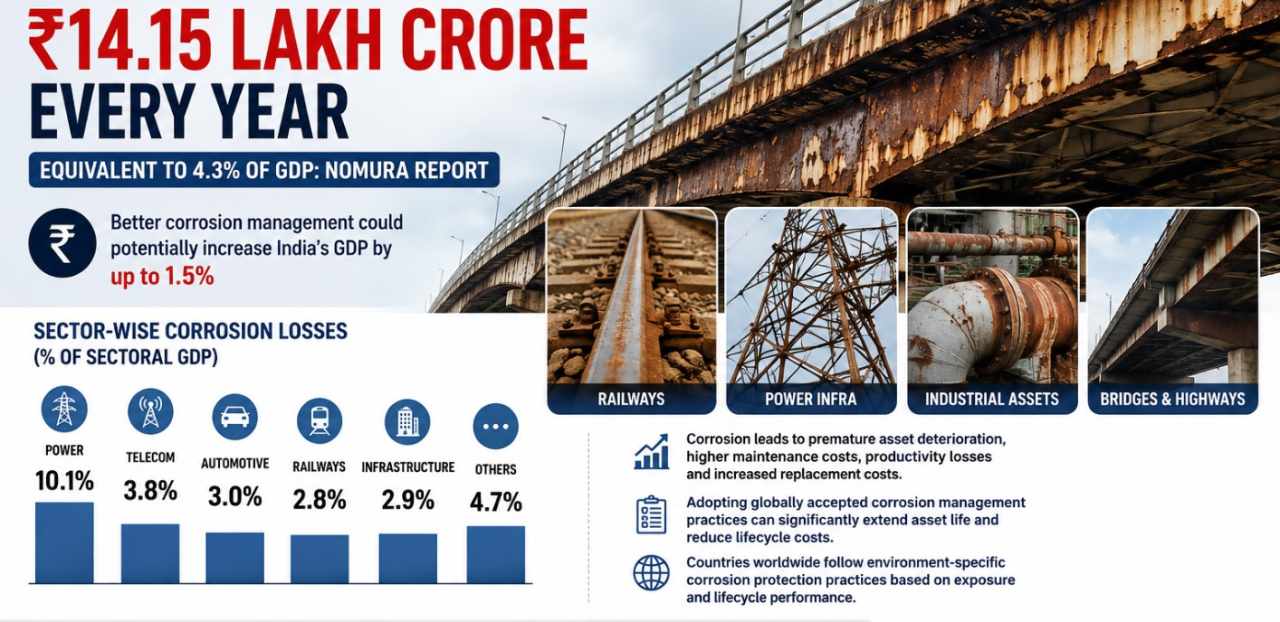
New Delhi: Corrosion is costing the Indian economy an
estimated ₹14.15 lakh crore annually, which is 4.3% of the country's Gross
Domestic Product (GDP), according to a recent Nomura report which also shows
the major economic impact of deterioration of critical infrastructure and
industrial assets.
Corrosion affects highways,
bridges, railways, power infrastructure, telecommunications, buildings and
industrial facilities, resulting in premature asset deterioration, increased
maintenance expenditure, productivity losses and higher replacement costs, the
report says.
Power has the highest economic
burden among the sectors, with corrosion-related losses estimated to be 10.1%
of sectoral GDP, followed by telecommunications (3.8%), automobiles (3.0%) and
railways (2.8%).
According to the report, India’s
corrosion-related losses are significantly higher than those in many developed
economies due to climatic conditions, extensive coastline, high humidity,
industrial pollution and varying environmental exposure across the country.
The study suggests that global
standard corrosion control and preventive measures could increase India's GDP
by up to 1.5% and there are the economic benefits of improving infrastructure
resilience and asset life.
Several developed countries have
adopted environment-specific corrosion protection practices where
infrastructure protection systems are based on local climate and environmental
conditions. Such an approach improves durability, minimizes maintenance costs
and optimises lifecycle costs.
As such, the report says,
infrastructure owners globally employ various corrosion protection products,
depending on the operating environment and asset life cycle. Among those are
zinc galvanization, protective coatings, weathering steel and other engineering
solutions which are selected on the basis of their lifespan and cost
effectiveness (in terms of maintenance and maintenance cost). Industry experts
have argued that expanding more widely the global corrosion protection
methodologies can not only help in maintaining India's infrastructure but also
help in reducing the maintenance costs in the long run.
The report also indicates that infrastructure projects in India are generally implemented in a uniform way despite significant differences in climatic conditions across regions. Heavy-humidity, coastal and industrial conditions lead to more aggressive corrosion and faster deterioration, which leads to higher maintenance needs.
The study also highlights the
imperative for preventive corrosion management through better engineering
standards, better compliance mechanisms, periodic inspection and maintenance
practices and wider adoption of internationally accepted corrosion protection
technologies for different operating environments.
According to the report,
corrosion management in infrastructure planning can significantly reduce
long-term maintenance expenditure, improve the productivity of public assets,
conserve resources and increase the overall efficiency of infrastructure investments.
With India leading the world in
infrastructure development, the report indicates that improving durability and
extending public asset service life will be important to maximising returns on
infrastructure investments while reducing the long-term economic burden of
corrosion.