·
Fertiliser
industry has improved energy efficiency by 36.6% in ammonia and 38.3% in urea
plants since 1987-88; industry leaders call for continued technology upgrades
and knowledge sharing
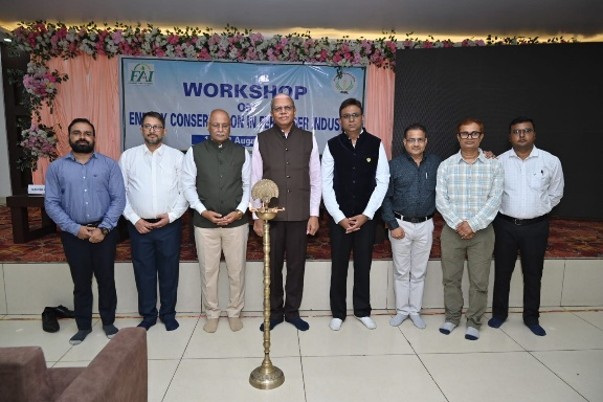
New Delhi : The Fertiliser Association of India (FAI) has organised
a program on Energy Conservation during 19-22 August 2026 at Barauni. The basic
objective of the program is to bring together senior executives from fertiliser
plants, technology suppliers and industry stakeholders to exchange plant-level
experiences and identify further opportunities for energy conservation. This
program will focus on energy efficiency, plant reliability and technology
upgrades.
Addressing the participants,
Dr. Suresh Kumar Chaudhari, Director General, FAI, highlighted that the
fertiliser industry is among the most energy-intensive sectors, with urea
production accounting for about 95% of the sector’s energy intensity. He noted
that India imports more than 50% of its natural gas requirement, while the
fertiliser sector remains one of the largest consumers of natural gas. With
energy efficiency already at a high level, he stressed that further gains would
require continued technology upgrades, plant revamps and knowledge sharing.
Dr Chaudhari added, “Energy
conservation is no longer merely desirable; it is essential for the
sustainability and competitiveness of the fertiliser industry. Our industry has
made significant progress, but as efficiency improves, further gains become
increasingly challenging. This makes it even more important to share
experiences, identify practical solutions and learn from the successes and
challenges of different plants.”
DG FAI acknowledged the
continued support of Dr. Siba Prasad Mohanty, Co-Chairman, FAI for the activities
and initiatives aimed at capacity building, knowledge sharing, and bringing new
learnings and industry experiences to the fertiliser fraternity.
The sector’s efforts have
resulted in significant improvements in energy efficiency. The weighted average
energy consumption of ammonia plants has improved by 36.6%, from 12.48 Gcal per
MT in 1987-88 to 7.91 Gcal per MT in 2025-26, while that of urea plants has
improved by 38.3%, from 8.87 to 5.47 Gcal per MT during the same period. The
Government has also tightened energy consumption norms for urea units for the
period from 1 April 2025 to 31 March 2028, further increasing the focus on
efficiency.
Speaking on the occasion,
Mr. R. K. Chopra, Managing Director, KRIBHCO Fertilizers Limited, said, “Many
fertiliser plants have similar designs and technologies and consequently face
common operational challenges. Greater sharing of plant-level experiences,
including on issues such as waste-heat boilers and cooling towers, can help the
industry learn from one another and address these challenges more effectively.
Such knowledge-sharing is the need of the hour.”
Earlier Mr. Nitin Saxena,
Business Unit Head, HURL said, “Energy reduction is critical to improving
costs, reducing the subsidy burden on the Government and advancing
sustainability. As HURL progresses with new urea projects and green ammonia
production, it is equally important to focus on plant reliability and greater
integration of renewable energy. Sharing experiences from new projects can help
the industry move forward collectively.”
The workshop is covering
energy conservation efforts across urea, ammonia and complex fertiliser plants,
including plant retrofits, improved catalysts and heat-exchanger designs,
waste-heat recovery, optimisation of steam and power consumption, and greater
use of renewable energy.
Mr. Manish Goswami, Chief
Technical, FAI, also provided valuable inputs to the participants.