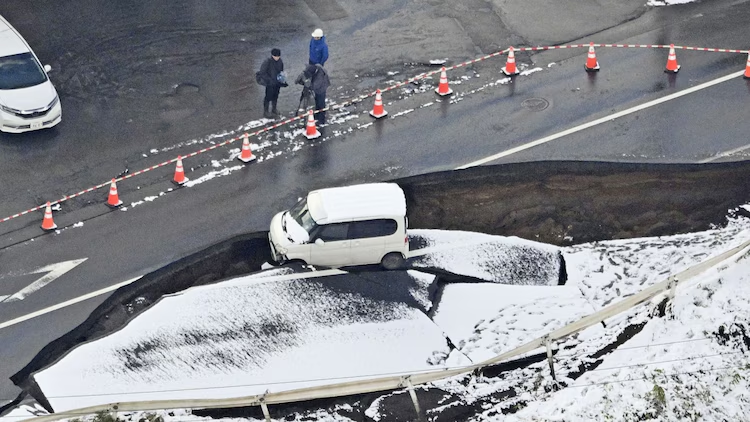
Japan has issued a rare megaquake advisory after a powerful 7.5-magnitude earthquake struck off the northern coast of the country on December 8, 2025. The quake hit near Aomori Prefecture late at night and was also followed by a smaller 6.9-magnitude tremor a few days later, keeping authorities alert for possible further strong shocks.
The Japan Meteorological Agency (JMA) issued the advisory because strong earthquakes in certain high-risk zones like the Japan Trench and Kuril Trench in the Pacific Ocean can sometimes be followed by even larger tremors. These deep ocean trenches are formed where one tectonic plate slides under another, creating conditions where a “megaquake” (magnitude 8.0 or higher) could occur. This advisory does not predict an earthquake, but signals a temporarily elevated chance of a stronger one in the coming days.
The initial earthquake caused injuries to dozens of people, some structural damage, small tsunami waves up to about 70 cm (2 feet) high and temporary evacuations of coastal communities. Tsunami warnings were first issued and later downgraded to advisories as waves stayed smaller than feared.
While the heightened alert is specific to Japan’s seismic setting, it has renewed global attention on earthquake risks in other active fault regions, including the Himalayan Faultline that runs beneath northern India, Nepal, Bhutan, and parts of Pakistan. The Himalayan region is formed by the slow collision of the Indian Plate and Eurasian Plate, which builds stress in the Earth’s crust over many decades. When this stress is released suddenly, it can trigger a major earthquake of magnitude 8 or more, often referred to as the Great Himalayan Earthquake.
Experts emphasise, however, that a Japanese megaquake does not directly cause Himalayan earthquakes, as the two regions are far apart and not connected by the same tectonic structures. But Japan’s alert serves as a reminder that active fault zones anywhere in the world can host large quakes, and that preparedness and awareness are important.
Scientists caution that while the risk of a big earthquake can be described in broader terms, earthquakes cannot be predicted precisely, not by exact date, time, or location. Instead, authorities and residents are urged to stay ready with emergency plans, safe buildings, and disaster supplies in earthquake-prone regions.