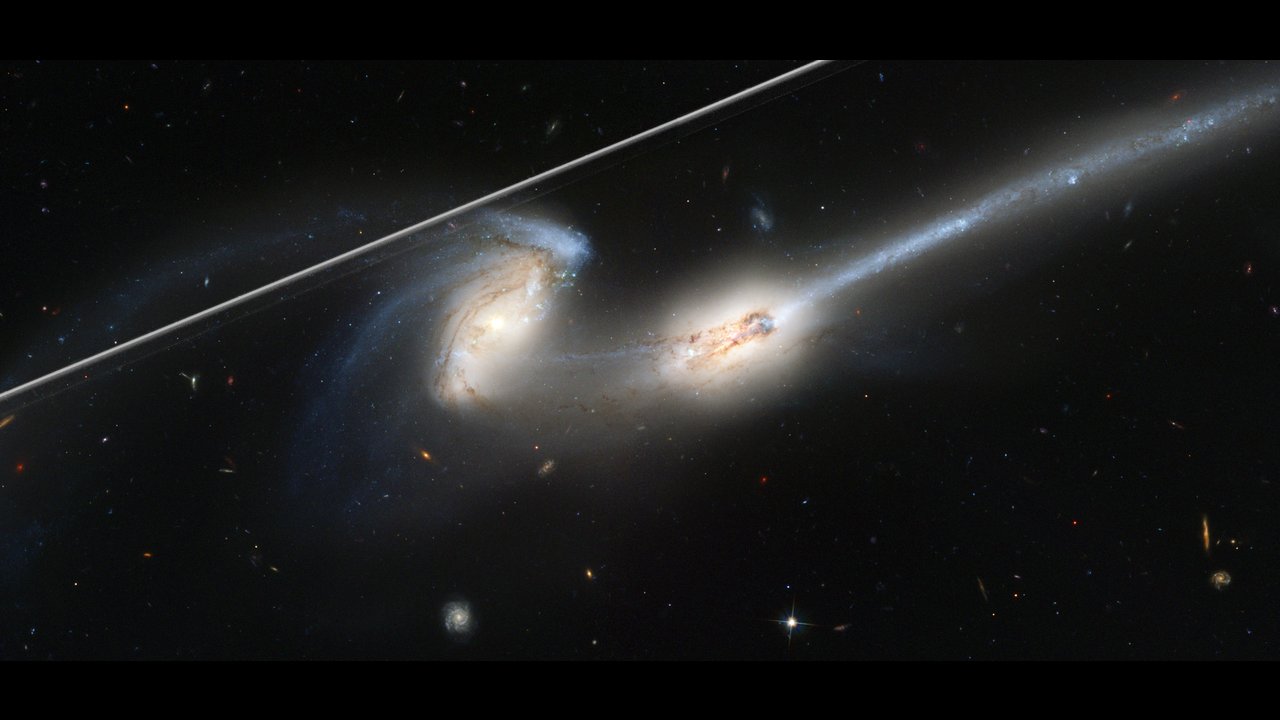
NASA’s Hubble Space Telescope, one of the most powerful and long-serving observatories in space, is facing a surprising new challenge. Its photos of the universe are increasingly being distorted. The reason is not a technical failure, but it is an interference from the rapidly growing number of satellites orbiting Earth.
What Is Happening to Hubble’s Images?
Hubble captures incredibly detailed views of distant galaxies, stars and nebulae from its orbit high above Earth. But a new study shows that bright streaks of light from satellites passing through its field of view are now appearing in its images. This problem is getting worse as more satellites are launched.
Scientists say that as many as around 40% of Hubble’s photos could be affected by satellite light streaks in the coming decade. This makes it harder to see faint and distant objects clearly.
Why So Many Satellites?
Companies around the world are launching giant networks of satellites to provide high-speed internet.
In 2019, Earth had about 2,000 satellites. By 2025, we’re already near 15,000. And in the future, we could see hundreds of thousands.
All those shiny metal bodies floating above us are beginning to show up in places we never expected, including Hubble’s universe-spanning photos.
Why It Matters
Hubble isn’t just a machine. For millions of people around the world, it’s a storyteller of the cosmos.
Its images have shown us:
-
Newborn stars are lighting up clouds of gas
-
Galaxies colliding millions of light-years away
-
The oldest light in the universe
-
The beauty of space we could never see on our own
Seeing those images disrupted is a reminder of how crowded our skies are becoming and how important it is to protect our view of the universe.
Astronomers Are Worried, But Not Hopeless
No one wants Hubble’s incredible view of the universe to fade. Scientists are now working with satellite companies to find solutions like making satellites less reflective, adjusting their heights, or coordinating flight paths.