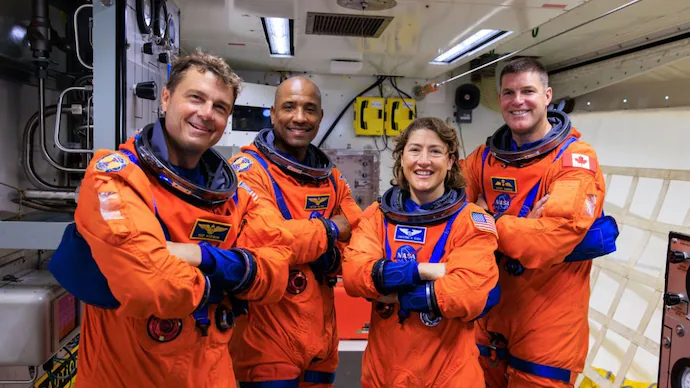
NASA’s Artemis II mission has achieved a major milestone as its crew successfully reached the Moon’s gravitational zone, marking a historic moment in space exploration. This mission is now on track to set a new record for the farthest distance humans have ever traveled from Earth.
The achievement comes more than 50 years after humans last went beyond Earth’s orbit, making Artemis II one of the most important space missions of modern times.
Historic Journey Beyond Earth
The four astronauts aboard the Orion spacecraft have now entered the Moon’s sphere of influence, meaning they are close enough to be affected by the Moon’s gravity. This mission is expected to reach a maximum distance of around 406,773 kilometres from Earth, breaking the previous record set by Apollo 13 in 1970.
In simple terms, no human has ever traveled this far into space before. The spacecraft will go beyond the Moon and then begin its journey back to Earth.
The mission launched on April 1, 2026, and is part of NASA’s Artemis program, which aims to return humans to the Moon and eventually send astronauts to Mars.
What Will Happen During the Mission
Artemis II is not a landing mission. Instead, it is a crewed test flight designed to check how the Orion spacecraft performs in deep space.
The astronauts will fly around the Moon in what is called a lunar flyby. During this phase, they will pass the far side of the Moon, a region that humans have not seen directly in decades.
They are also expected to:
- Capture rare images of the Moon and Earth
- Observe the Moon’s surface and study possible future landing sites
- Experience a temporary communication blackout when the spacecraft goes behind the Moon
One of the most interesting parts of the mission is the free-return trajectory. This means the spacecraft uses the Moon’s gravity to naturally swing back toward Earth without needing extra fuel.
Why This Mission Is Important
Artemis II is a key step in NASA’s long-term space goals. It is the first crewed mission under the Artemis program and will help scientists understand how humans can safely travel in deep space.
The mission will also prepare for future projects like:
- Landing astronauts on the Moon again (planned in upcoming Artemis missions)
- Building a long-term human presence on the Moon
- Sending humans to Mars in the future
Experts say this mission is not just about breaking records but about opening a new era of space exploration.
Final Thoughts
The Artemis II mission is a powerful reminder of how far human space exploration has come. By traveling farther than ever before, astronauts are pushing the limits of what is possible. As the spacecraft completes its journey around the Moon and heads back to Earth, it brings us one step closer to returning humans to the lunar surface and eventually exploring even deeper space.