·
Innovations
shone across telemedicine, AI-driven diagnostics, predictive analytics, mental
health support, chronic disease management, maternal/child health, mobile
diagnostics, emergency systems, affordable devices, environmental health
resilience, digital literacy, pharmacy access, and elderly care.
Sehore : VIT Bhopal University, in
collaboration with Johns Hopkins University, Whiting School of Engineering, USA,
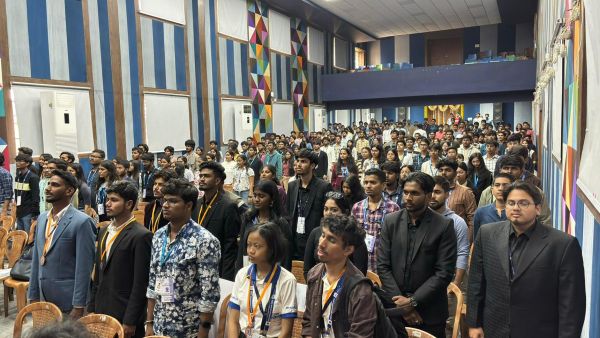
successfully concluded Health-Hack 2026, a three-day (February 10-12, 2026)
international hackathon focused on advancing innovation in healthcare, and
developing transformative solutions aimed at shaping the future of healthcare
technology. The event brought together leading academicians, researchers,
policymakers, clinicians, and young innovators to design scalable solutions
under the theme “Improving Health Access for All.”
The event was inaugurated under
the leadership of Chancellor, VIT Bhopal
University, Dr. G. Viswanathan, and supported by Vice President Mr. Sankar Viswanathan, Assistant Vice President Ms.
Kadhambari S. Viswanathan; Trustee Mrs. Ramani Balasundaram; Co-Patron from
Johns Hopkins University, Dr. Sridevi Sarma, Vice Dean for Graduate Education,
Whiting School of Engineering; Professor, Department of Biomedical Engineering;
Associate Director, Johns Hopkins University, USA. The traditional
lamp-lighting ceremony marked the opening, symbolising a shared commitment to
innovation in healthcare.
The pre-hackathon workshop on
February 10 had distinguished speakers including Chief Guest Dr. Ram Bilas Pachori, Professor, IIT
Indore; Guests of Honour Dr. Santosh Kumar Vishvakarma, Chief Scientific Officer,
AIGGPA, Government of Madhya Pradesh & Professor, IIT Indore, and Dr.
Mukesh Kumar, Professor, IIT Indore. The workshop created a dynamic
platform for meaningful engagement, interdisciplinary learning, and the
development of impactful healthcare solutions.
Delivering the welcome address at
the inaugural session on February 11, Dr. T. B. Sridharan, Pro Vice Chancellor,
VIT Bhopal University, underscored the transformative role of technology in
bridging healthcare gaps and creating sustainable, inclusive solutions for
underserved communities.
The event featured keynote
addresses by global experts including Dr.
Hedy Alavi, Convenor, Associate Dean for Global Partnerships; Program Chair for
Environmental Engineering, Science, Management, and Sustainability Programs
(EP), Whiting School of Engineering, Johns Hopkins University, USA.
Dr. Alavi emphasized the
transformative power of collaborative innovation in bridging gaps in healthcare
accessibility worldwide. He highlighted how interdisciplinary partnerships
between engineers, public health experts, and emerging technologists can drive
sustainable solutions that make advanced healthcare tools more equitable and
reachable, especially in underserved regions. Dr. Alavi stressed that true
progress in accessible healthcare technology stems not just from cutting-edge
inventions, but from global cooperation that prioritizes inclusivity,
environmental sustainability, and real-world impact to ensure no community is
left behind in the pursuit of better health outcomes.
Guest of Honor, Dr. Veerendra Kumar, Director of Technical
Education, Madhya Pradesh, underscored the importance of healthcare
innovation in shaping the future, while Chief Guest Dr. Arun Balakrishnan, Advisor to CEO, Chief Innovation Officer at OmniActives
Health Technologies, stressed the need for deeper collaboration between
industry and academia.
At the valedictory session, Dr.
Sridharan delivered the welcome address, emphasizing technology-driven
healthcare advancements, followed by a keynote by Dr. Youseph Yazdi, Convenor, Associate Professor, Biomedical
Engineering, Executive Director at the Center for Bioengineering Innovation and
Design (CBID), Whiting School of Engineering, Johns Hopkins University, USA.
Dr. Yazdi captivated the audience
with his keynote on building powerful innovation ecosystems capable of
delivering scalable healthcare solutions for pressing global needs. Drawing on
his role leading the Johns Hopkins Center for Bioengineering Innovation and
Design, he explained that breakthrough medical technologies succeed through
disciplined needs-driven design, seamless clinician-engineer partnerships, and
a disciplined journey from idea to commercialization, particularly to close
gaps in care for underserved and remote populations. Inspiring the next wave of
change-makers, he showcased the potential of interdisciplinary student teams to
drive rapid progress in telemedicine, affordable diagnostics, and chronic
illness management, urging them to center users, uphold ethics, and commit to
sustainable impact in reshaping equitable healthcare access around the world.
The hackathon witnessed a good
number of national and international participation. In the first evaluation
phase held in January 2026, 579 teams comprising 2,767 participants from IITs,
NITs, IIITs, government medical colleges, and international institutions
competed. Of these, 231 teams, representing 1,160 participants, advanced to the
final round at VIT Bhopal.
Participants worked across tracks
including telemedicine, AI-driven diagnostics, predictive analytics, mental
health support, chronic disease management, maternal and child health, pharmacy
access, environmental health resilience, and elderly care.
The top three winners were:
First Prize (₹1,00,000): Team
Eternia, Parul University, Gujarat, comprising team members: Priyanshi Rathore,
Yash Kumar Khatik, Gaurav Shah, Pratik Sontakke – for a secure digital platform
addressing mental health accessibility among students.
Second Prize (₹50,000): Team
KBNU-B, Khaja Bandanawaz University, Karnataka, comprising team members:
Shruthi V M, Abhilash Hirapur, Afeefa Naseem, Mohammed Oweis, Azhar Ali, Shaikh
Sohali Ali – for “SwasthPath,” an AI-powered digital health scheme navigator
offering multilingual and voice-enabled support.
Third Prize (₹25,000): Team
Methxai, VIT Bhopal University, comprising team members: Aniket Kumar, Dhruv
Prasad Warrier, Rohan Jaria, Devyani Hemraj Bidve, Akshara Shah, Kushagra Divya
– for an AI-powered medicine vending system ensuring 24x7 access to essential
OTC medicines.
The winners were awarded medals,
certificates, and cash prizes by the Pro Vice Chancellor, Registrar, and Deans
of VIT Bhopal University.
Dr. Siddhartha Maiti and Dr.
Siddharth Singh Chouhan, Convenors of Health-Hack 2026, highlighted the event’s
role in bridging academia and industry to foster meaningful healthcare
advancements. A summary of the hackathon proceedings was presented by Dr. Anju
Shukla, followed by a Vote of Thanks delivered by Dr. Lakshmi D.
Health-Hack 2026 showcased disciplined,
needs-driven innovation blending software, hardware, and hybrid technologies.
The event reinforced VIT Bhopal University’s commitment to research-led
education, global collaboration, and technology that delivers measurable social
impact.
With strong academic leadership
and international partnerships, the university continues to position itself as
a catalyst for equitable healthcare innovation and future-ready talent.