·
Dr.
Lalit Bhasin calls for settlement and mediation over prolonged disputes as the
two-day symposium on "Role of Law to Promote the Culture of Peace"
concludes
Pune:
"The test of a legal system is not how it treats the powerful, but how it
protects the ordinary citizen. Equality before the law means that justice is
blind to wealth, status or background," said Justice Sunil B. Shukre,
Chairman, Maharashtra Lokayukta and former Judge, Bombay High Court, who
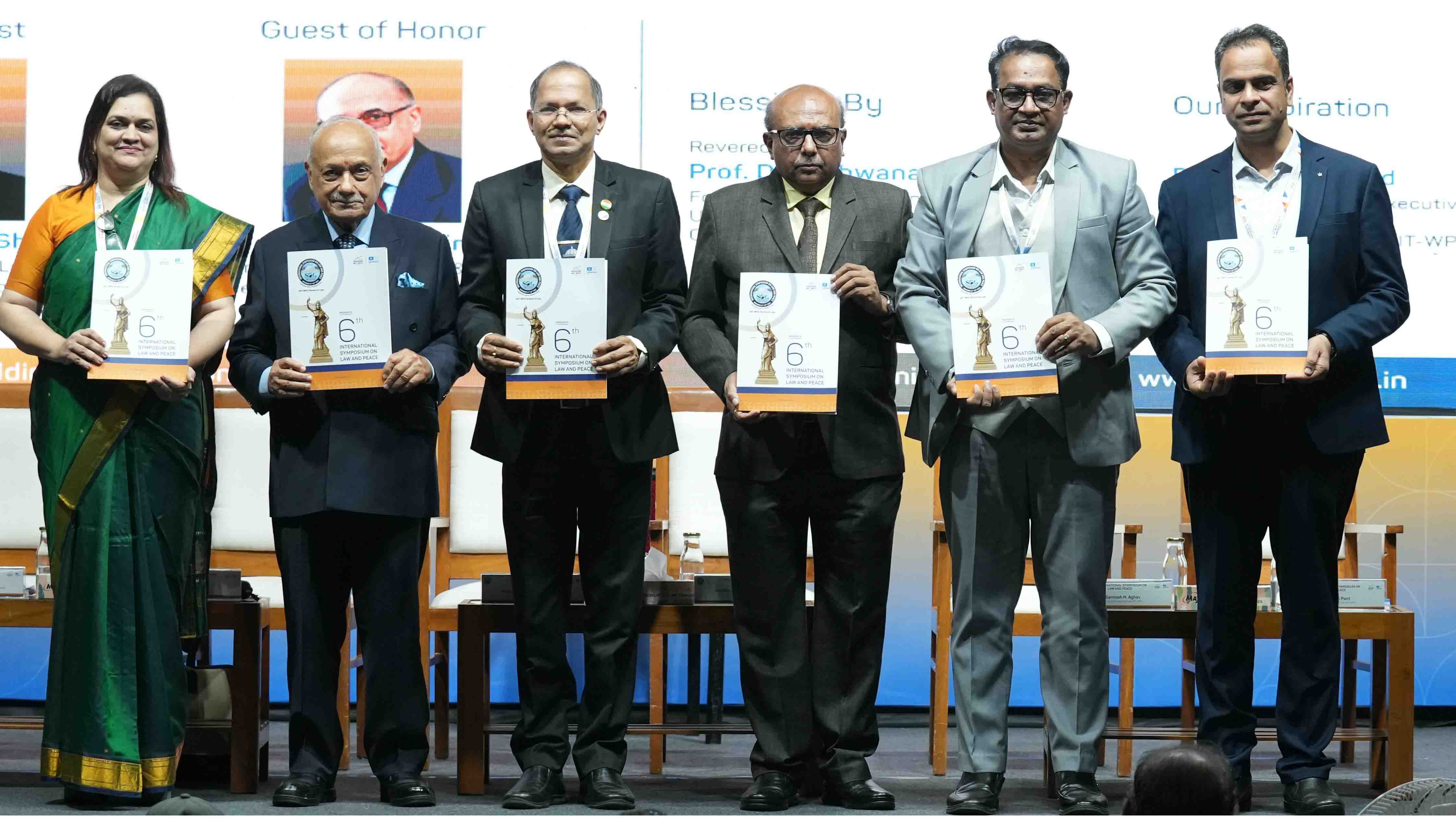
was the Chief Guest at the inauguration session of the two-day-long 6th
International Symposium on Law and Peace, organised by the School of Law, MIT
World Peace University (MIT-WPU).
Dr.
Lalit Bhasin,
Managing Partner, Bhasin & Company and President, Society of Indian Law
Firms, was the Guest of Honour. Dr. Raviraja N. Seetharam, Vice Chancellor,
MIT-WPU; Dr. Santosh Aghav, Dean, School of Law; Dr. Pournima Inamdar,
Associate Dean (External Relations), Justice R. C. Chavan, Former Judge of the
Bombay High Court and Prof. Priyankar Upadhyaya, UNESCO Chair for Peace, BHU,
and Senior Advisor, MIT-WPU were among the dignitaries present at the
inauguration session.
Stressing
that justice depends on how laws are applied, Justice Shukre said that laws
need to be implemented equally and without discrimination. Even a good law, he
said, fails when the people responsible for it are careless or unjust. "If
those who implement the law do not care about justice, are careless, do not have
any empathy, then the law would be a toothless tiger," he said. Describing
law as a vehicle for delivering justice, Justice Shukre said, "The concept
of justice lies central to the theme of peace."
Speaking
as Guest of Honour, Dr. Lalit Bhasin added that arbitration in India has not
taken off because of long delays and judicial intervention. "There are
long delays. I know because I appear also before the arbitral tribunal. If some
date is given today, the matter is adjourned after six months," he said,
adding that "the client loses faith in the system."
Urging
law schools to build negotiation skills among students, he said, "This
skill development of negotiations has to be developed in the student community
of this country." Addressing students directly, he said, "Our
generation has failed… the responsibility is on you, the young students, to
introduce this element of peace." He described settling disputes as part
of students' future duty as lawyers. "To settle your dispute is also a
part of your professional social responsibility when you become lawyers,"
he said.
Earlier,
Dr. Raviraja N. Seetharam, Vice Chancellor, MIT-WPU, said: "The
symposium aims to promote peace and harmony in global society through
law-making processes and policy decisions, by imbibing the principles of
justice, equity and good conscience. It seeks to sensitise budding legal
professionals as conflict resolution ambassadors by initiating dialogue among
lawyers, judges, policymakers, jurists, academicians, youth, society and
industry on the legal dimensions and perspectives of peace."
Justice
R. C. Chavan, Former
Judge of the Bombay High Court and Chief Guest at the valedictory session,
emphasised the need for a progressive and dynamic approach to constitutional
interpretation. Drawing upon Dr. B. R. Ambedkar's observations during the
Constituent Assembly debates on Article 368 and the philosophy of Thomas
Jefferson, he highlighted that constitutional principles and legal
interpretations must remain responsive to the changing needs and realities of
society. He cautioned against an uncritical adherence to judicial precedents
and outdated statutory provisions, underscoring the importance of allowing each
generation the space to address its own challenges while remaining guided by
constitutional values.
Guest
of Honour at the valedictory session, Prof. Priyankar Upadhyaya, UNESCO
Chair for Peace, BHU, and Senior Advisor, MIT-WPU, drew on Mahatma Gandhi's
thought to say that peace is more than the absence of war. It needs truth,
non-violence and justice, he said, and lasting peace begins with the conduct of
the individual. For legal professionals, this means treating law as an instrument
of reconciliation rather than only of conflict.
Dr.
Santosh Aghav, Dean, School of Law, delivered the welcome address, and Dr.
Pournima Inamdar, Associate Dean (External Relations), proposed the vote of
thanks. Justice Shukre thanked Prof. Dr. Vishwanath D. Karad, Founder, MIT-WPU
and Chief Patron, and Dr. Rahul V. Karad, Executive President, MIT-WPU, for the
invitation.
The
two-day symposium featured sessions on the "Role of Law in Export-Import,
Trade and Commerce," the "Evolving Landscape of Alternative Dispute
Resolution in the Age of Technology," "Conflict Related to Energy and
Renewable Resources," and "Changing Dynamics of Cybersecurity in the
Age of AI." Together, the sessions reflected the symposium's central
message that law, applied with justice and backed by a willingness to settle,
can lead society towards peace.