India proposed for an Annual
India–Australia Skills Meet to Drive Harmonised Standards
New Delhi : As
part of the 3rd Australia–India Education and Skills Council (AIESC) Meeting
in New Delhi, India and Australia convened a substantive bilateral dialogue to
advance cooperation in skills development, workforce mobility, and the rapidly
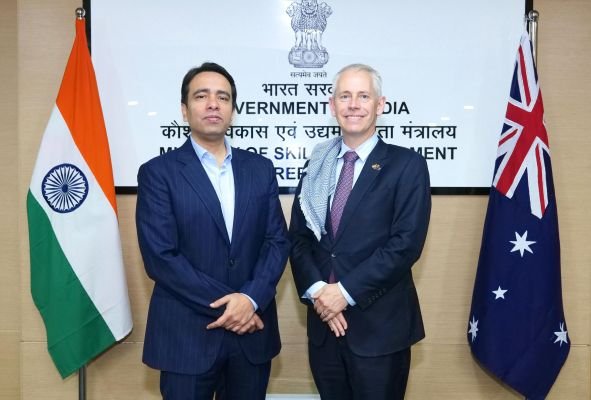
growing sports economy. The bilateral meeting was co-chaired by Shri Jayant
Chaudhary, Hon’ble Minister of State (Independent Charge) for Skill
Development and Entrepreneurship & Minister of State for Education, and Hon.
Andrew Giles MP, Minister for Skills & Training, Commonwealth of
Australia.
The deliberations acknowledged
the strong upward trajectory in India–Australia relations and reinforced the
need to translate this momentum into well-structured pathways for the movement
of skilled professionals. Both sides agreed to accelerate operationalisation of
the Mutual Recognition of Qualifications (MRQ) mechanism and to
co-design bridge courses that align competencies and facilitate seamless
mobility. Particular emphasis was laid on preparing skilled workers for global
standards in advanced construction, given Australia’s infrastructure
expansion ahead of major sporting events.
A key element of the discussions
revolved around the strategic opportunities emerging from India’s bid for
the 2030 Commonwealth Games and Australia’s hosting of the 2032 Brisbane
Olympics and Paralympics. The sports and physical wellness sector was
collectively recognised as a sunrise industry with significant employment
prospects and potential to contribute nearly 2% to India’s GDP.
Australia’s global leadership in sports management, sports technology, was
identified as a complementary strength to India’s expanding sports
manufacturing and gig-economy landscape.
Further collaboration was
proposed between India’s skilling institutions — including ITIs and National
Skill Training Institutes (NSTIs) — and Australia’s TAFE network,
with joint work expected in areas spanning mining, digital and IT skills,
hospitality, green jobs, renewable energy, and logistics.
Shri Jayant Chaudhary also
underlined India’s commitment to future-oriented skills under the Skilling
for AI Readiness (SOAR) initiative, along with the importance of joint
ethical frameworks and standards for digital adoption. The ministers agreed
that responsible and high-quality workforce mobility must guide
bilateral cooperation going forward.
Speaking on the occasion, Shri
Jayant Chaudhary stated: “India and Australia are natural partners in
shaping the global workforce of the future. By strengthening pathways, aligning
standards, and leveraging each other’s sectoral strengths, we can enable youth
to access global opportunities while supporting dynamic industry needs in both
our economies. I also propose that we establish an annual India-Australia
Skills Meet, held alternately in India and Australia. This platform can drive
harmonisation and equivalence in selected skills, deepen institutional
partnerships, and keep our training ecosystems aligned with industry needs in
both countries.”
“Australia is one of India’s most
important partners in this space. We also explored new avenues in
sports-related skilling ahead of major global events, including joint training,
curriculum development and industry partnerships,” he further added.
Hon. Andrew Giles MP
remarked that Australia deeply values its partnership with India and as our
nations prepare for major sporting and economic milestones, skills cooperation
will play a vital role in ensuring shared prosperity and measurable impact for
our people.
The meeting witnessed
participation from senior officials of MSDE, the Directorate General of
Training, NCVET, NSDC and representatives from the Australian Department of
Education and its Skills and Training agencies.
The bilateral session concluded
with a shared resolve to maintain high-level engagement and fast-track
collaborative models that enhance training quality, strengthen global mobility,
and contribute to building future-ready skill ecosystems in both countries.