
·
Rising gold prices led to a significant expansion in gold loans,
contributing to healthy retail credit growth in the post-festive period
·
The share of younger borrowers within the
first-time borrower segment increased, particularly in consumer durable loans
and personal loans
·
Retail credit growth, boosted by the rationalisation
of Goods and Services Tax (GST) rates, stabilised, notably from the second
month after the festive period
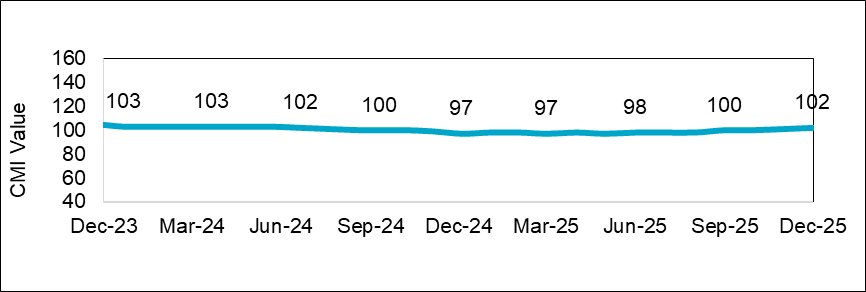
Mumbai – India’s Credit Market Indicator (CMI)1 rose in the December
2025 quarter both year-over-year (YoY) and quarter-over-quarter (QoQ),
supported by strong growth in gold loans amid a sharp increase in global gold
prices. However, retail credit supply normalised in the post-festive period, easing
from the momentum created by the rationalisation of Goods and Services Tax
(GST) and returning to end of 2024 levels, indicating a seasonal moderation in
short-term demand.
TransUnion CIBIL’s March 2026 Credit
Market Report indicates that the Consumer Credit Market Indicator
(CMI) increased to 102 for the quarter ended December 2025, up from 97 in the
quarter ended December 2024.The December 2025 CMI is also higher by two points
from 100 in the preceding quarter of September 2025. The December 2025 quarter CMI
marked the third consecutive quarter of improvement.
The CMI is a
comprehensive measure of data elements that are summarised monthly to analyse
changes in credit market health, categorised under four pillars: demand,
supply, consumer behaviour, and performance. These factors are combined into a
single, comprehensive CMI indicator, and can also be viewed in more detail
individually. A higher CMI reading indicates improving credit market health, whereas
a lower reading indicates a decline.
“There is
evidence of a shift in retail credit growth dynamics, with momentum extending
beyond secured products such as gold loans to rising consumption demand from
first-time and younger borrowers. While the post-festive moderation in credit
supply reflects seasonal trends, the overall improvement in credit performance
reinforces the strength and maturity of India’s credit market,’’ said Mr.
Bhavesh Jain, MD and CEO, TransUnion CIBIL.
Chart
1: Credit Market Indicator (CMI) Dec 2023 – Dec 2025
Non-metro
Geographies, New-to-Credit2 Consumers Drive Credit Demand
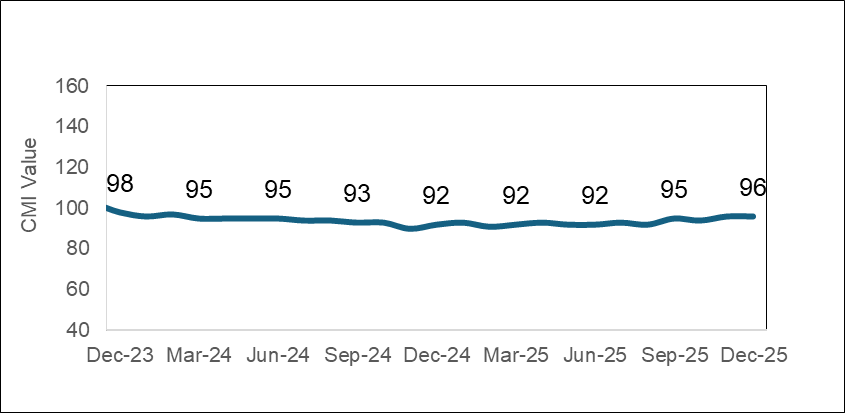
The CMI for
demand increased to 96 in the December 2025 quarter from 92 in the December
2024 quarter, buoyed by strong demand from semi-urban and rural consumers.
Their share of the total retail borrower base rose to 54%, an increase of three
percentage points over the year-ago period. The share of New-to-Credit
consumers also increased by one percentage point to 15% of total borrowers.
During the
post-festive period, auto loan volumes improved in line with last year’s
levels, primarily supported by increased supply in the affordable mid‑segment car category (INR 5–10 lakh). In the post festive
period, the average daily supply grew by 10% in auto loans in 2025, compared to
2024.
Chart
2: CMI for Demand Dec 2023 – Dec 2025
“The continued
expansion of credit demand in non-metro and semi-urban markets underscores the
structural shift underway in India’s lending landscape. As access to formal
credit deepens beyond traditional urban centres, we are seeing a more
geographically diversified borrower base emerge. This trend reflects improving
credit awareness enhanced distribution by lenders and the growing relevance of
tailored products for these segments, all of which are contributing to a more
inclusive and balanced credit ecosystem,’’ Mr. Jain said.
Credit
Supply Increases on the Back of Gold Loans
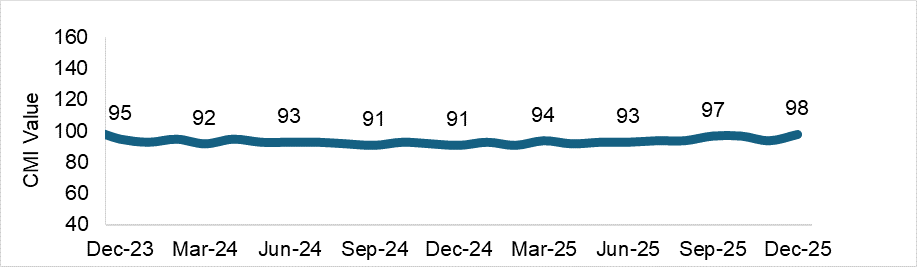
The CMI for
supply rose to 98 in the December 2025 quarter from 91 in the December 2024
quarter, largely driven by a significant increase in both the volume and value
of gold loans. This growth was supported by higher-ticket gold loans availed by
consumers seeking to benefit from rising gold prices.
Since March 2023,
the average gold loan ticket size has increased by 1.8X times driving a sharp
rise in origination value. The indexed growth (indexed to March 2023) in the
gold loan average ticket size touched 189 points in the quarter ended December
2025, compared to 132 in the quarter-ended December 2024. The average ticket
size for the three months ended December 2025 stands at INR 1.9 lakh. Gold loans
now represent the largest share by volume (36%) and value (39%) among all
retail loan categories, accounting for more than one third of the total retail
loan supply. In terms of outstanding balances, gold loans are now second only to
housing loans.
From a geographic
and demographic perspective, gold loans are expanding beyond their traditional concentration
in southern states and seeing higher growth in northern and western states. For
instance, as of December 2025, the three states with above average YoY growth
rates in gold loan origination volumes were Uttar Pradesh – 96%, Madhya Pradesh
– 80% and Rajasthan – 79%. Additionally, more than half, 54%, are being utilised
by prime and above consumers indicating a more diverse credit profile. This trend
also highlights the growing acceptance of gold loans as a mainstream retail
credit product.
Chart
3: CMI for Supply Dec 2023 – Dec 2025
Consumption-led
Credit Revives First-Time Borrower Segment
The
first-time-borrowers (FTB)3 segment grew 7% by originating consumers
YoY in the December 2025 quarter, supported by strong momentum in consumption-led
credit. Within this segment, personal loans recorded a 20% YoY increase,
compared to a 3% decline in the quarter ended December 2024. Similarly, consumer
durable loans grew 22% YoY, reversing an 11% decline in the year-ago period.
Additionally,
borrowers below 35 years old increased by 17% YoY in the December 2025 quarter,
compared to a 3% decrease in the December 2024 quarter. This group now constitutes
58% of the FTB segment, and is a key contributor towards its overall growth.
CMI
for Performance Increases by Six Points
Improved balance
level 90+ days past due (DPD) delinquencies across key product segments led to
the CMI for performance increasing by six points to 107 in December 2025, from 101
in December 2024. The micro-loan against property (LAP) segment was the only
category to exhibit some stress, with balance-level 90+ DPD delinquency increasing
by 35 basis points YoY to 3.1% in December 2025. Despite this increase,
delinquency levels have remained broadly stable and range‑bound since the previous quarter.
“India’s retail
credit landscape continues to demonstrate resilience and structural depth,
supported by a healthy balance between consumption-led demand and improving
credit performance. Higher
origination volumes in home, auto, and consumer durable loans point to a steady
shift toward asset-backed borrowing. Concurrently, rising average loan sizes
and a growing share of prime and above borrowers indicate sustained lender
focus towards credit tested profiles. This reflects evolving borrower
preferences as well as lenders’ ability to adapt to changing credit requirements.
“At the same
time, rising participation from first-time borrowers, younger consumers, and
non-metro geographies points to a broader formalisation of credit and
increasing financial inclusion. As the ecosystem matures, maintaining a strong focus
on credit discipline and risk management will remain critical to ensure sustainable
long-term growth,’’ said Mr. Jain.